Stateinterpreter (characterizing DeepTICA states)
Reference paper: Novelli, Bonati, Pontil and Parrinello, JCTC (2023)
Prerequisite: LASSO tutorial.

Setup
[1]:
# Colab setup
import os

if os.getenv("COLAB_RELEASE_TAG"):
    import subprocess
    subprocess.run('wget https://raw.githubusercontent.com/luigibonati/mlcolvar/main/colab_setup.sh', shell=True)
    cmd = subprocess.run('bash colab_setup.sh EXAMPLE', shell=True, stdout=subprocess.PIPE)
    print(cmd.stdout.decode('utf-8'))

# IMPORT PACKAGES
import torch
import lightning
import numpy as np
import matplotlib.pyplot as plt
import mlcolvar.utils.plot

# Set seed for reproducibility
torch.manual_seed(1)
/home/etrizio@iit.local/Bin/miniconda3/envs/mlcvs_test/lib/python3.10/site-packages/tqdm/auto.py:22: TqdmWarning: IProgress not found. Please update jupyter and ipywidgets. See https://ipywidgets.readthedocs.io/en/stable/user_install.html
  from .autonotebook import tqdm as notebook_tqdm
[1]:
<torch._C.Generator at 0x7fbdc04804f0>
This is a short tutorial to interpret the states starting from the sign structure of the eigenfunctions of TICA, as done in this paper.
Load DeepTICA data
We will use the DeepTICA CVs trained for the alanine dipeptide, contained in the md-stateinterpreter repository.
[2]:
from mlcolvar.io import create_dataset_from_files
from mlcolvar.data import DictModule

filenames = [ "https://github.com/luigibonati/md-stateinterpreter/raw/main/tutorials/alanine/COLVAR_DeepTICA" ]
# load dataset
dataset, df = create_dataset_from_files(filenames,
                                        filter_args={'regex':'d_' }, # select distances
                                        return_dataframe=True,
                                        index_col=0)

df
Class 0 dataframe shape:  (50001, 56)

 - Loaded dataframe (50001, 56): ['time', 'phi', 'psi', 'theta', 'xi', 'ene', 'd_2_5', 'd_2_6', 'd_2_7', 'd_2_9', 'd_2_11', 'd_2_15', 'd_2_16', 'd_2_17', 'd_2_19', 'd_5_6', 'd_5_7', 'd_5_9', 'd_5_11', 'd_5_15', 'd_5_16', 'd_5_17', 'd_5_19', 'd_6_7', 'd_6_9', 'd_6_11', 'd_6_15', 'd_6_16', 'd_6_17', 'd_6_19', 'd_7_9', 'd_7_11', 'd_7_15', 'd_7_16', 'd_7_17', 'd_7_19', 'd_9_11', 'd_9_15', 'd_9_16', 'd_9_17', 'd_9_19', 'd_11_15', 'd_11_16', 'd_11_17', 'd_11_19', 'd_15_16', 'd_15_17', 'd_15_19', 'd_16_17', 'd_16_19', 'd_17_19', 'ecv.ene', 'opes.bias', 'DeepTICA 1', 'DeepTICA 2', 'walker']
 - Descriptors (50001, 45): ['d_2_5', 'd_2_6', 'd_2_7', 'd_2_9', 'd_2_11', 'd_2_15', 'd_2_16', 'd_2_17', 'd_2_19', 'd_5_6', 'd_5_7', 'd_5_9', 'd_5_11', 'd_5_15', 'd_5_16', 'd_5_17', 'd_5_19', 'd_6_7', 'd_6_9', 'd_6_11', 'd_6_15', 'd_6_16', 'd_6_17', 'd_6_19', 'd_7_9', 'd_7_11', 'd_7_15', 'd_7_16', 'd_7_17', 'd_7_19', 'd_9_11', 'd_9_15', 'd_9_16', 'd_9_17', 'd_9_19', 'd_11_15', 'd_11_16', 'd_11_17', 'd_11_19', 'd_15_16', 'd_15_17', 'd_15_19', 'd_16_17', 'd_16_19', 'd_17_19']
[2]:
| time | phi | psi | theta | xi | ene | d_2_5 | d_2_6 | d_2_7 | d_2_9 | ... | d_15_17 | d_15_19 | d_16_17 | d_16_19 | d_17_19 | ecv.ene | opes.bias | DeepTICA 1 | DeepTICA 2 | walker | |
|---|---|---|---|---|---|---|---|---|---|---|---|---|---|---|---|---|---|---|---|---|---|
| 0 | 0.0 | -2.36867 | 2.64432 | -0.202258 | 0.048056 | -41.45820 | 0.152064 | 0.233505 | 0.241173 | 0.379827 | ... | 0.130073 | 0.244001 | 0.227324 | 0.281913 | 0.148169 | -41.45820 | 0.000000 | 0.884022 | 0.697792 | 0 |
| 1 | 1.0 | -1.81603 | 2.26247 | 0.155789 | -0.162735 | -34.46170 | 0.154673 | 0.238446 | 0.246100 | 0.392822 | ... | 0.130751 | 0.248974 | 0.224416 | 0.287066 | 0.149815 | -34.46170 | 0.000000 | 0.904663 | 0.441770 | 0 |
| 2 | 2.0 | -1.96164 | 2.52240 | -0.071315 | 0.419557 | -22.81000 | 0.153296 | 0.248231 | 0.245643 | 0.384574 | ... | 0.133494 | 0.240812 | 0.219853 | 0.267548 | 0.146985 | -22.81000 | 0.000000 | 0.901740 | 0.715535 | 0 |
| 3 | 3.0 | -1.55273 | 2.61161 | -0.073188 | -0.322301 | -19.42730 | 0.146842 | 0.233290 | 0.238608 | 0.375124 | ... | 0.133732 | 0.243859 | 0.218035 | 0.273935 | 0.141663 | -19.42730 | 0.000000 | 0.889557 | 0.327383 | 0 |
| 4 | 4.0 | -1.43251 | 1.05203 | 0.210149 | -0.033460 | -31.27380 | 0.150544 | 0.238910 | 0.240522 | 0.374435 | ... | 0.135397 | 0.254622 | 0.223741 | 0.285824 | 0.149050 | -31.27380 | 0.000000 | 0.895487 | -0.841115 | 0 |
| ... | ... | ... | ... | ... | ... | ... | ... | ... | ... | ... | ... | ... | ... | ... | ... | ... | ... | ... | ... | ... | ... |
| 49996 | 49996.0 | -2.71024 | 3.09736 | -0.278662 | -0.145443 | -17.50420 | 0.150316 | 0.237027 | 0.236800 | 0.371655 | ... | 0.133984 | 0.245352 | 0.224751 | 0.283270 | 0.138847 | -17.50420 | 1.543530 | 0.870904 | 0.345046 | 0 |
| 49997 | 49997.0 | -2.73993 | -3.07790 | -0.066902 | -0.030009 | -9.98505 | 0.160066 | 0.240604 | 0.251294 | 0.387740 | ... | 0.131298 | 0.245222 | 0.229207 | 0.287379 | 0.149105 | -9.98505 | 0.983428 | 0.880671 | 0.498947 | 0 |
| 49998 | 49998.0 | -1.79181 | 2.41757 | 0.454768 | 0.175903 | 28.20660 | 0.144505 | 0.220241 | 0.251352 | 0.389548 | ... | 0.136430 | 0.243374 | 0.227492 | 0.275568 | 0.144445 | 28.20660 | -14.739900 | 0.936590 | 0.497335 | 0 |
| 49999 | 49999.0 | -2.25492 | 2.65134 | -0.023274 | 0.166437 | -31.68510 | 0.146304 | 0.232403 | 0.241591 | 0.381665 | ... | 0.133528 | 0.245209 | 0.224884 | 0.281453 | 0.144545 | -31.68510 | 1.717750 | 0.890656 | 0.782703 | 0 |
| 50000 | 50000.0 | -1.30765 | 1.08041 | -0.120033 | 0.027040 | -20.90940 | 0.156149 | 0.247190 | 0.243012 | 0.387217 | ... | 0.137467 | 0.249259 | 0.231183 | 0.290996 | 0.142807 | -20.90940 | 1.633530 | 0.892738 | -0.800826 | 0 |
50001 rows × 56 columns
Lasso classifier (2 states)
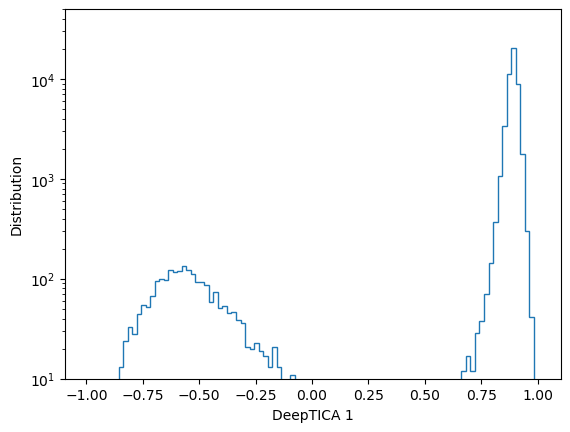
If we look at the distribution of DeepTICA 1 we see that it identifies two states, which we can label accordingly:
[3]:
fig, ax = plt.subplots()
ax.hist(df['DeepTICA 1'].values,bins=100,histtype='step')
ax.set_yscale('log')
ax.set_ylim(1e1,5e4)
ax.set_xlabel('DeepTICA 1')
ax.set_ylabel('Distribution')
[3]:
Text(0, 0.5, 'Distribution')
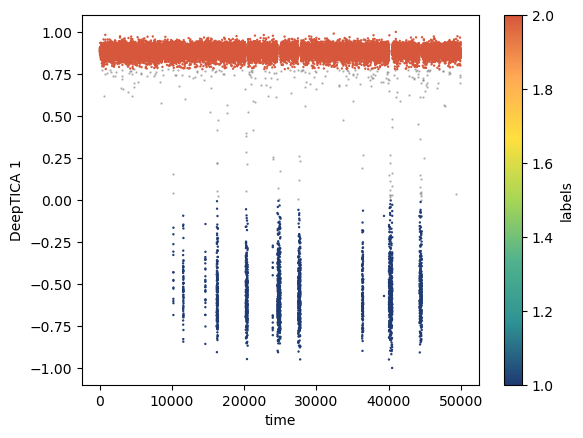
Create labels
[5]:
labels = np.zeros(len(df))
labels[np.argwhere(df['DeepTICA 1'].values > 0.78)] = 2
labels[np.argwhere(df['DeepTICA 1'].values < -0.)] = 1
df['labels'] = labels

fig,ax = plt.subplots()
df[df['labels']==0].plot.scatter('time','DeepTICA 1',c='grey', s=0.5,alpha=0.5,ax=ax)
df[df['labels']!=0].plot.scatter('time','DeepTICA 1',c='labels', s=0.5,cmap='fessa',ax=ax)
[5]:
<AxesSubplot:xlabel='time', ylabel='DeepTICA 1'>
Create dataset with angles or distances
[6]:
from mlcolvar.data import DictDataset

sel = (df['labels'] != 0 )

descr_type = 'angles' #'distances'

if descr_type == 'angles':
    # get descriptors
    X = df[sel].filter(regex='phi|psi|xi|theta').values[::10]
    feat_names = df[sel].filter(regex='phi|psi|xi|theta').columns.values

    # convert to sine and cosine
    X = np.hstack((np.sin(X),np.cos(X)))
    feat_names = [f'sin_{i}' for i in feat_names]+[f'cos_{i}' for i in feat_names]

    # get labels
    y = df[sel]['labels'].values[::10]

elif descr_type == 'distances':
    # get descriptors
    X = df[sel].filter(regex='d_').values[::10]
    feat_names = df[sel].filter(regex='d_').columns.values

    # get labels
    y = df[sel]['labels'].values[::10]

# create dataset
dataset = DictDataset(dict(data=X,labels=y))
dataset.feature_names = feat_names
dataset
[6]:
DictDataset( "data": [4976, 8], "labels": [4976] )
Perform classification
[7]:
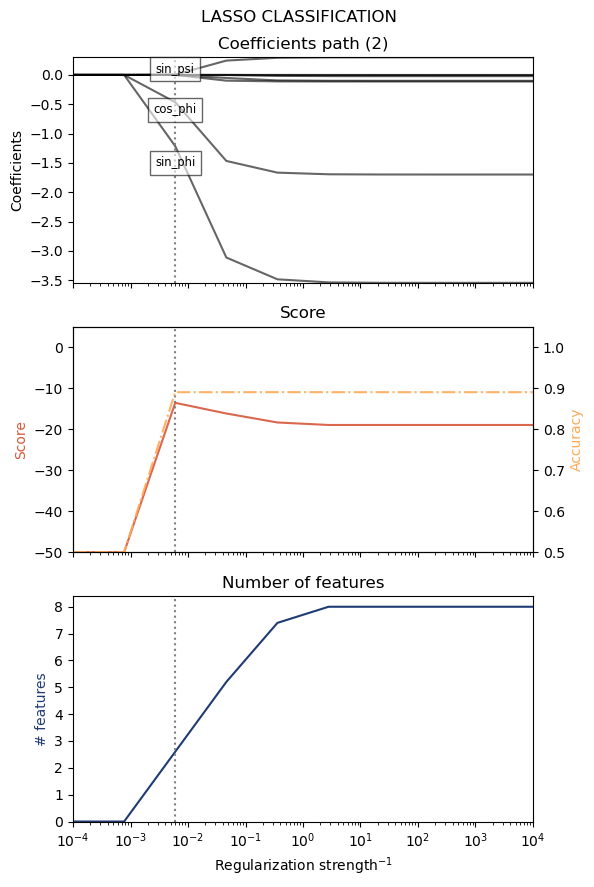
from mlcolvar.explain.lasso import lasso_classification

classifier, feats, coeffs = lasso_classification(dataset, Cs=10, plot=True)
======= LASSO results (2) ========
- Regularization : 0.00599484
- Score          : -13.58
- Accuracy       : 89.42%
- # features     : 3

Features:
(1) sin_phi      : -1.556827
(2) cos_phi      : -0.656852
(3) sin_psi      : 0.040250
==================================
Lasso classifier (3 states, one vs rest)
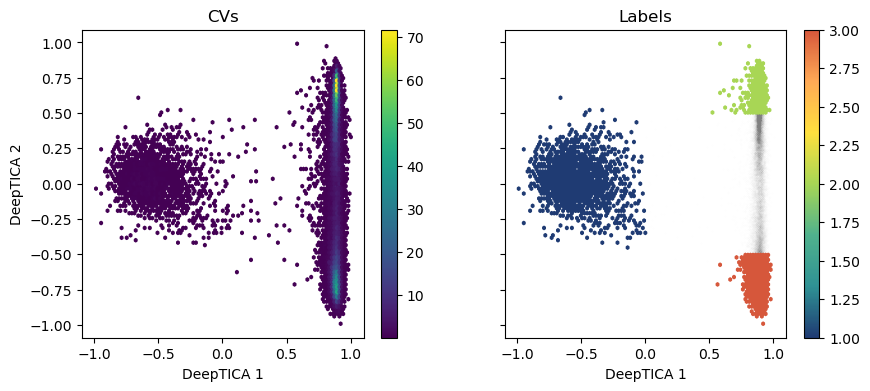
If we look instead at both DeepTICA 1 and DeepTICA 2 variables, we see that they identify three distinct states. We can then interpret them using a classifier for each state (‘one vs rest’) which returns the features that distinguish that state from all the others.
[9]:
fig,axs = plt.subplots(1,2,figsize=(10,4),sharex=True,sharey=True)

ax = axs[0]
pp = ax.hexbin(df['DeepTICA 1'],df['DeepTICA 2'], C = np.ones(len(df)), reduce_C_function = lambda x: np.sum(x)/10 )
plt.colorbar(pp,ax=ax)

ax = axs[1]

labels = np.zeros(len(df))
labels[np.argwhere( (df['DeepTICA 1'].values < 0) )] = 1
labels[np.argwhere( (df['DeepTICA 1'].values > 0.5) & (df['DeepTICA 2'].values > 0.5) )] = 2
labels[np.argwhere( (df['DeepTICA 1'].values > 0.5) & (df['DeepTICA 2'].values < -0.5) )] = 3
df['labels'] = labels

df[df['labels']==0].plot.scatter('DeepTICA 1','DeepTICA 2',c='grey', s=0.1,alpha=0.01,ax=ax)
df[df['labels'] != 0].plot.hexbin('DeepTICA 1','DeepTICA 2',C='labels', cmap='fessa',ax=ax)

titles = ['CVs','Labels']
for i,ax in enumerate(axs):
    ax.set_xlabel('DeepTICA 1')
    ax.set_ylabel('DeepTICA 2')
    ax.set_title(titles[i])
Create new dataset
[10]:
from mlcolvar.data import DictDataset

sel = (df['labels'] != 0 )

descr_type = 'angles'#'distances' #

if descr_type == 'angles':
    # get descriptors
    X = df[sel].filter(regex='phi|psi|xi|theta').values[::10]
    feat_names = df[sel].filter(regex='phi|psi|xi|theta').columns.values

    # convert to sine and cosine
    X = np.hstack((np.sin(X),np.cos(X)))
    feat_names = [f'sin_{i}' for i in feat_names]+[f'cos_{i}' for i in feat_names]

    # get labels
    y = df[sel]['labels'].values[::10]

elif descr_type == 'distances':
    # get descriptors
    X = df[sel].filter(regex='d_').values[::10]
    feat_names = df[sel].filter(regex='d_').columns.values

    # get labels
    y = df[sel]['labels'].values[::10]

# create dataset
dataset = DictDataset(dict(data=X,labels=y))
dataset.feature_names = feat_names
dataset
[10]:
DictDataset( "data": [3331, 8], "labels": [3331] )
Perform classification
[11]:
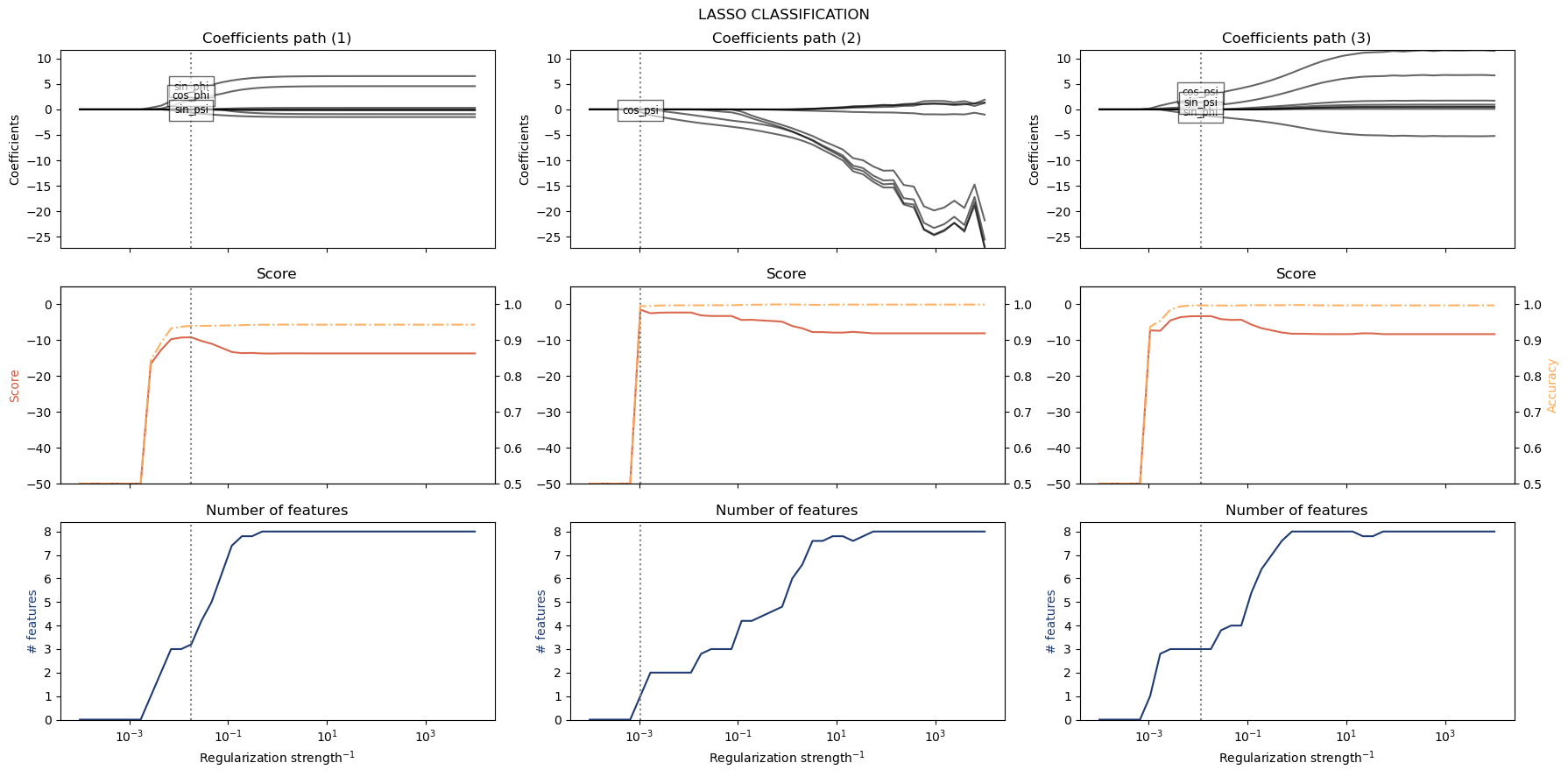
classifier, feats, coeffs = lasso_classification(dataset, plot = False)
======= LASSO results (1) ========
- Regularization : 0.01804722
- Score          : -9.23
- Accuracy       : 93.77%
- # features     : 3

Features:
(1) sin_phi      : 3.842064
(2) cos_phi      : 2.095998
(3) sin_psi      : -0.727435
==================================

======= LASSO results (2) ========
- Regularization : 0.00106082
- Score          : -1.54
- Accuracy       : 99.46%
- # features     : 1

Features:
(1) cos_psi      : -0.836221
==================================

======= LASSO results (3) ========
- Regularization : 0.01125336
- Score          : -3.35
- Accuracy       : 99.65%
- # features     : 3

Features:
(1) cos_psi      : 2.700127
(2) sin_phi      : -1.191376
(3) sin_psi      : 0.681767
==================================
Plot
[12]:
from mlcolvar.explain.lasso import plot_lasso_classification

plot_lasso_classification(classifier,feats,coeffs)