TPI-DeepTDA: Chignolin mini-protein
Reference paper: Ray, Trizio and Parrinello, JCP (2023) [arXiv].
Prerequisite: DeepTDA tutorial.

Setup
[4]:
# Colab setup
import os

if os.getenv("COLAB_RELEASE_TAG"):
    import subprocess
    subprocess.run('wget https://raw.githubusercontent.com/luigibonati/mlcolvar/main/colab_setup.sh', shell=True)
    cmd = subprocess.run('bash colab_setup.sh EXAMPLE', shell=True, stdout=subprocess.PIPE)
    print(cmd.stdout.decode('utf-8'))

# IMPORT PACKAGES
import torch
import lightning
import numpy as np
import matplotlib.pyplot as plt

# Set seed for reproducibility
torch.manual_seed(42)
[4]:
<torch._C.Generator at 0x7fd09b4f46b0>
Chignolin protein
We first train a DeepTDA CV on the chignolin data, which is one of the examples of the TPI-Deep-TDA paper. This is a small protein often used for testing as it prvide a simple example of folding dynamics in protein. Indeed, chignolin in water presents two metastable states, folded and unfolded, and the interconversion between them involves several degrees of freedom.
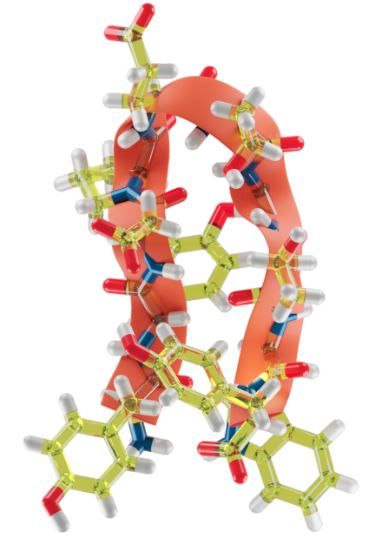
Image credits: Narjes Ansari
Deep-TDA
We will use the folding of Chignolin protein as an example for the application of TPI-Deep-TDA as presented in TPI-Deep-TDA paper. As descriptors we will use the contacts between the \(\alpha\)-carbon of the protein chain.
[1]:
from mlcolvar.io import create_dataset_from_files
from mlcolvar.data import DictModule

filenames = [ "https://raw.githubusercontent.com/dhimanray/TPI_deepTDA/main/chignolin/training/folded/contacts_folded_25000",
              "https://raw.githubusercontent.com/dhimanray/TPI_deepTDA/main/chignolin/training/unfolded/contacts_unfolded_25000"]

n_states = len(filenames)

# load dataset
# here we only load part of the data to speed up the training, change stop to 25000 and stride to 1 to use them all for better results
dataset, df = create_dataset_from_files(filenames,
                                        create_labels=True,
                                        return_dataframe=True,
                                        filter_args={'regex':'cont' }, # select distances between heavy atoms
                                        stop=10000,
                                        stride=2)

datamodule = DictModule(dataset,lengths=[0.8,0.2])
/home/etrizio@iit.local/Bin/miniconda3/envs/mlcvs_test/lib/python3.10/site-packages/tqdm/auto.py:22: TqdmWarning: IProgress not found. Please update jupyter and ipywidgets. See https://ipywidgets.readthedocs.io/en/stable/user_install.html
  from .autonotebook import tqdm as notebook_tqdm
Class 0 dataframe shape:  (5000, 47)
Class 1 dataframe shape:  (5000, 47)

 - Loaded dataframe (10000, 47): ['cont1', 'cont2', 'cont3', 'cont4', 'cont5', 'cont6', 'cont7', 'cont8', 'cont9', 'cont10', 'cont11', 'cont12', 'cont13', 'cont14', 'cont15', 'cont16', 'cont17', 'cont18', 'cont19', 'cont20', 'cont21', 'cont22', 'cont23', 'cont24', 'cont25', 'cont26', 'cont27', 'cont28', 'cont29', 'cont30', 'cont31', 'cont32', 'cont33', 'cont34', 'cont35', 'cont36', 'cont37', 'cont38', 'cont39', 'cont40', 'cont41', 'cont42', 'cont43', 'cont44', 'cont45', 'walker', 'labels']
 - Descriptors (10000, 45): ['cont1', 'cont2', 'cont3', 'cont4', 'cont5', 'cont6', 'cont7', 'cont8', 'cont9', 'cont10', 'cont11', 'cont12', 'cont13', 'cont14', 'cont15', 'cont16', 'cont17', 'cont18', 'cont19', 'cont20', 'cont21', 'cont22', 'cont23', 'cont24', 'cont25', 'cont26', 'cont27', 'cont28', 'cont29', 'cont30', 'cont31', 'cont32', 'cont33', 'cont34', 'cont35', 'cont36', 'cont37', 'cont38', 'cont39', 'cont40', 'cont41', 'cont42', 'cont43', 'cont44', 'cont45']
Model
Here we use as target a series of three consecutive Gaussians, the second one will be broader as it is related to the TPE data
[2]:
from mlcolvar.cvs import DeepTDA

n_cvs = 1
target_centers = [-7,7]
target_sigmas = [0.2, 0.2]
nn_layers = [45,24,12,1]
# MODEL
model = DeepTDA(n_states=n_states, n_cvs=1,target_centers=target_centers, target_sigmas=target_sigmas, model=nn_layers)
We initialize the lightining.Trainer and Fit the model.
[5]:
from mlcolvar.utils.trainer import MetricsCallback

# define callbacks
metrics = MetricsCallback()

# define trainer
# for better results we can also increase the number of epochs or use a early_stopping
trainer = lightning.Trainer(callbacks=[metrics],
                     max_epochs=500, logger=None, enable_checkpointing=False)

# fit
trainer.fit( model, datamodule )
GPU available: True (cuda), used: True
TPU available: False, using: 0 TPU cores
IPU available: False, using: 0 IPUs
HPU available: False, using: 0 HPUs
Missing logger folder: /home/etrizio@iit.local/Bin/dev/mlcolvar/docs/notebooks/examples/lightning_logs
LOCAL_RANK: 0 - CUDA_VISIBLE_DEVICES: [0]

  | Name    | Type          | Params | In sizes | Out sizes
-----------------------------------------------------------------
0 | loss_fn | TDALoss       | 0      | ?        | ?
1 | norm_in | Normalization | 0      | [45]     | [45]
2 | nn      | FeedForward   | 1.4 K  | [45]     | [1]
-----------------------------------------------------------------
1.4 K     Trainable params
0         Non-trainable params
1.4 K     Total params
0.006     Total estimated model params size (MB)
/home/etrizio@iit.local/Bin/miniconda3/envs/mlcvs_test/lib/python3.10/site-packages/lightning/pytorch/loops/fit_loop.py:280: PossibleUserWarning: The number of training batches (1) is smaller than the logging interval Trainer(log_every_n_steps=50). Set a lower value for log_every_n_steps if you want to see logs for the training epoch.
  rank_zero_warn(
Epoch 499: 100%|██████████| 1/1 [00:00<00:00, 22.68it/s, v_num=0]
`Trainer.fit` stopped: `max_epochs=500` reached.
Epoch 499: 100%|██████████| 1/1 [00:00<00:00, 21.80it/s, v_num=0]
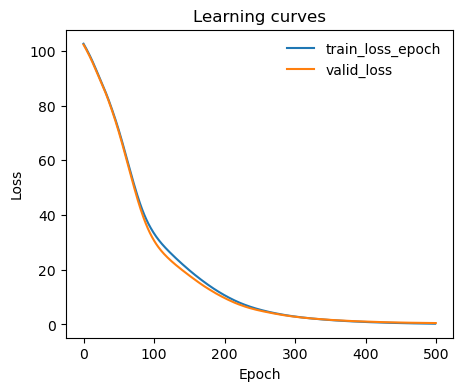
Learning curve
[6]:
from mlcolvar.utils.plot import plot_metrics

ax = plot_metrics(metrics.metrics,
                  keys=['train_loss_epoch','valid_loss'],
                  #linestyles=['-.','-'], colors=['fessa1','fessa5'],
                  yscale='linear')
Analysis of the CV
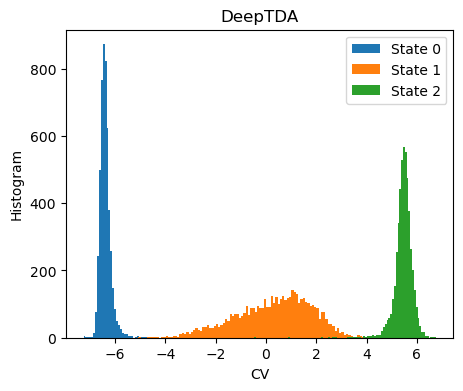
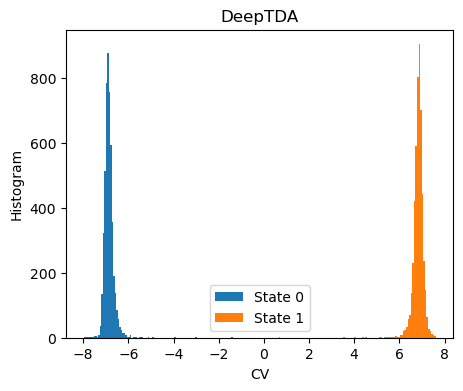
The histogram of the training data along th CVs should match the target distribution
[7]:
fig,ax = plt.subplots( 1, 1, figsize=(5,4) )

X = dataset[:]['data']
Y = dataset[:]['labels']

with torch.no_grad():
    s = model(torch.Tensor(X)).numpy()

for i in range(n_states):
    s_red = s[torch.nonzero(Y==i, as_tuple=True)]
    ax.hist(s_red[:,0],bins=100, label=f'State {i}')

ax.set_xlabel(f'CV')
ax.set_ylabel('Histogram')
ax.set_title('DeepTDA')
plt.legend()
plt.show()
Transition State Informed Deep-TDA (TPI-DeepTDA)
We will now try to imporve our CV using the TPI-Deep-TDA method, as presented in TPI-Deep-TDA paper. As descriptors we will again use the contacts between the \(\alpha\)-carbon of the protein chain. The data from the trasition path ensemble was collected by running a series of OPES-Flooding simualtions biasing a Deep-TDA CV as the one trained above.
[8]:
from mlcolvar.io import create_dataset_from_files
from mlcolvar.data import DictModule

filenames = [ "https://raw.githubusercontent.com/dhimanray/TPI_deepTDA/main/chignolin/training/folded/contacts_folded_25000",
              "https://raw.githubusercontent.com/dhimanray/TPI_deepTDA/main/chignolin/training/flooding/Contact_CV/contacts_ts_data",
              "https://raw.githubusercontent.com/dhimanray/TPI_deepTDA/main/chignolin/training/unfolded/contacts_unfolded_25000"]

n_states = len(filenames)

# load dataset
# here we only load part of the data to speed up the training, change stop to 25000 and stride to 1 to use them all for better results
dataset, df = create_dataset_from_files(filenames,
                                        create_labels=True,
                                        return_dataframe=True,
                                        filter_args={'regex':'cont' }, # select distances between heavy atoms
                                        stop=10000,
                                        stride=2)

datamodule = DictModule(dataset,lengths=[0.8,0.2])
Class 0 dataframe shape:  (5000, 47)
Class 1 dataframe shape:  (5000, 47)
Class 2 dataframe shape:  (5000, 47)

 - Loaded dataframe (15000, 47): ['cont1', 'cont2', 'cont3', 'cont4', 'cont5', 'cont6', 'cont7', 'cont8', 'cont9', 'cont10', 'cont11', 'cont12', 'cont13', 'cont14', 'cont15', 'cont16', 'cont17', 'cont18', 'cont19', 'cont20', 'cont21', 'cont22', 'cont23', 'cont24', 'cont25', 'cont26', 'cont27', 'cont28', 'cont29', 'cont30', 'cont31', 'cont32', 'cont33', 'cont34', 'cont35', 'cont36', 'cont37', 'cont38', 'cont39', 'cont40', 'cont41', 'cont42', 'cont43', 'cont44', 'cont45', 'walker', 'labels']
 - Descriptors (15000, 45): ['cont1', 'cont2', 'cont3', 'cont4', 'cont5', 'cont6', 'cont7', 'cont8', 'cont9', 'cont10', 'cont11', 'cont12', 'cont13', 'cont14', 'cont15', 'cont16', 'cont17', 'cont18', 'cont19', 'cont20', 'cont21', 'cont22', 'cont23', 'cont24', 'cont25', 'cont26', 'cont27', 'cont28', 'cont29', 'cont30', 'cont31', 'cont32', 'cont33', 'cont34', 'cont35', 'cont36', 'cont37', 'cont38', 'cont39', 'cont40', 'cont41', 'cont42', 'cont43', 'cont44', 'cont45']
Model
Here we use as target a series of three consecutive Gaussians, the second one will be broader as it is related to the TPE data
[9]:
from mlcolvar.cvs import DeepTDA

n_cvs = 1
target_centers = [-7,0,7]
target_sigmas = [0.2, 1.5, 0.2]
nn_layers = [45,24,12,1]
# MODEL
model = DeepTDA(n_states=n_states, n_cvs=1,target_centers=target_centers, target_sigmas=target_sigmas, model=nn_layers)
We initialize the lightining.Trainer and Fit the model.
[10]:
from mlcolvar.utils.trainer import MetricsCallback

# define callbacks
metrics = MetricsCallback()

# define trainer
# for better results we can also increase the number of epochs or use a early_stopping
trainer = lightning.Trainer(callbacks=[metrics],
                     max_epochs=500, logger=None, enable_checkpointing=False)

# fit
trainer.fit( model, datamodule )
GPU available: True (cuda), used: True
TPU available: False, using: 0 TPU cores
IPU available: False, using: 0 IPUs
HPU available: False, using: 0 HPUs
LOCAL_RANK: 0 - CUDA_VISIBLE_DEVICES: [0]

  | Name    | Type          | Params | In sizes | Out sizes
-----------------------------------------------------------------
0 | loss_fn | TDALoss       | 0      | ?        | ?
1 | norm_in | Normalization | 0      | [45]     | [45]
2 | nn      | FeedForward   | 1.4 K  | [45]     | [1]
-----------------------------------------------------------------
1.4 K     Trainable params
0         Non-trainable params
1.4 K     Total params
0.006     Total estimated model params size (MB)
/home/etrizio@iit.local/Bin/miniconda3/envs/mlcvs_test/lib/python3.10/site-packages/lightning/pytorch/loops/fit_loop.py:280: PossibleUserWarning: The number of training batches (1) is smaller than the logging interval Trainer(log_every_n_steps=50). Set a lower value for log_every_n_steps if you want to see logs for the training epoch.
  rank_zero_warn(
Epoch 499: 100%|██████████| 1/1 [00:00<00:00, 23.01it/s, v_num=1]
`Trainer.fit` stopped: `max_epochs=500` reached.
Epoch 499: 100%|██████████| 1/1 [00:00<00:00, 22.00it/s, v_num=1]
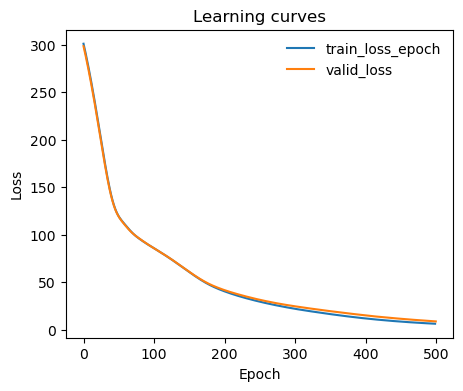
Learning curve
[11]:
from mlcolvar.utils.plot import plot_metrics

ax = plot_metrics(metrics.metrics,
                  keys=['train_loss_epoch','valid_loss'],
                  #linestyles=['-.','-'], colors=['fessa1','fessa5'],
                  yscale='linear')
Analysis of the CV
The histogram of the training data along th CVs should match the target distribution
[12]:
fig,ax = plt.subplots( 1, 1, figsize=(5,4) )

X = dataset[:]['data']
Y = dataset[:]['labels']

with torch.no_grad():
    s = model(torch.Tensor(X)).numpy()

for i in range(n_states):
    s_red = s[torch.nonzero(Y==i, as_tuple=True)]
    ax.hist(s_red[:,0],bins=100, label=f'State {i}')

ax.set_xlabel(f'CV')
ax.set_ylabel('Histogram')
ax.set_title('DeepTDA')
plt.legend()
plt.show()